

Introduction to the Election
The recent election of Phoebe Okowa to the International Court of Justice (ICJ) marks a significant moment in international law and diplomacy. This election process, which took place within the framework of the United Nations, involved both the General Assembly and the Security Council taking concurrent but independent actions. The election was conducted over several rounds of voting, reflecting the importance and high stakes associated with the positions available at the ICJ.
The voting commenced with the General Assembly, where member states cast their ballots to select candidates for the judicial seats that became vacant. Each member has the right to vote, which culminates in a democratic process aimed at fulfilling the principles of justice on the global stage. The procedure was characterized by both transparency and meticulous adherence to regulations mandated by the ICJ’s founding statute.
Simultaneously, the Security Council exercised its authority to recommend candidates, further adding a layer of complexity to the process. The interplay between the General Assembly and the Security Council highlights the collaborative yet distinct roles these two key UN bodies play in international judicial appointments. Both bodies must ensure that the chosen individuals embody the principles of justice, independence, and impartiality that the ICJ upholds.
The Voting Process Explained
The election of Phoebe Okowa to the International Court of Justice (ICJ) involved a structured and rigorous voting process that unfolded in multiple rounds. The process is governed by specific rules aimed at ensuring fairness and transparency in the selection of judges for this prestigious court, which is tasked with adjudicating disputes between states and providing advisory opinions on international legal issues.
Initially, the voting commenced with a slate of candidates, all vying for the position of judge on the ICJ. Each candidate needed to secure an absolute majority, which is defined as more than half of the total votes cast by the United Nations General Assembly and the Security Council combined. This requirement established a high threshold for electoral success, reflecting the importance of the role that ICJ judges play in upholding international law.
The voting process consisted of several rounds, during which candidates received votes from the members of both bodies. In the first round, none of the candidates achieved the requisite number of votes, prompting subsequent rounds. Over the following votes, the number of candidates gradually diminished as some nominations were withdrawn, typically due to strategic considerations or lack of sufficient support among member states.
Judge Okowa’s election was characterized by these dynamics. As certain opponents withdrew their nominations, the pool of candidates shrank, increasing her chances of obtaining the majority needed for election. Through strategic campaigning and emphasizing her qualifications, she managed to garner sufficient support across the voting bodies, ultimately leading to her successful election to the ICJ.
Overall, the voting process was a reflection not only of the candidates’ qualifications but also of the geopolitical landscape, which played a significant role in determining the outcomes of the various rounds of voting. This election underscores the complexity and significance of judicial selection in international law, demonstrating the intricate balance of diplomacy, advocacy, and legal expertise required for such prestigious positions.
Profile of Judge Phoebe Okowa
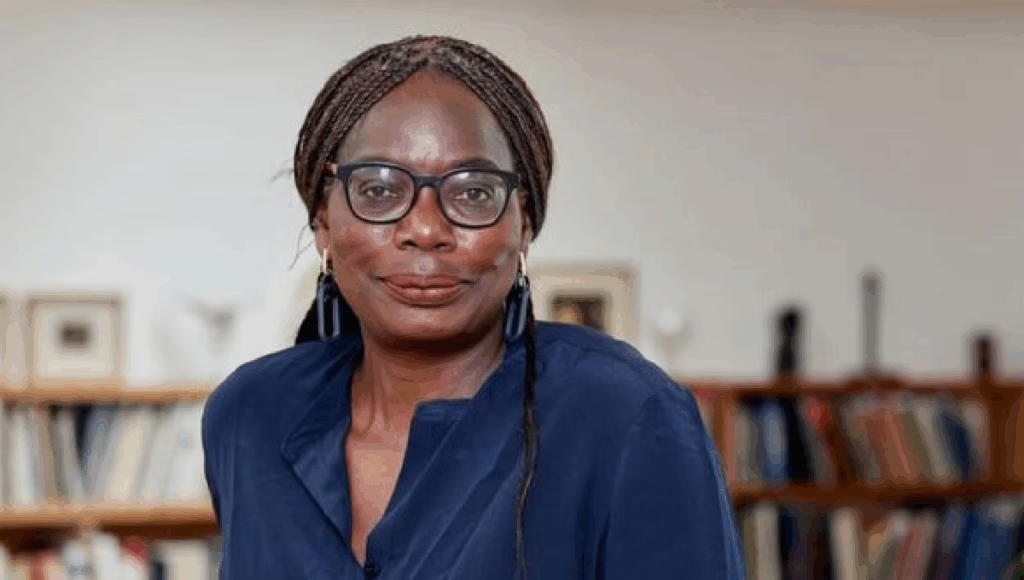
Judge Phoebe Okowa, a distinguished legal expert, has recently been elected to the International Court of Justice (ICJ), underscoring her remarkable career in the realm of international law. Her academic background is as impressive as her professional achievements, having developed a robust foundation in public international law. Judge Okowa obtained her undergraduate degree in law from the University of Nigeria, later honing her expertise by completing her Master’s and Doctorate at the University of Cambridge. This educational trajectory equipped her with critical analytical skills essential for navigating complex legal frameworks.
Throughout her illustrious career, Judge Okowa has held several significant positions in academia. Notably, she served as a Professor of Public International Law at Queen Mary University of London. In this capacity, she distinguished herself by providing valuable insights into international legal principles and their application. Her tenure at Queen Mary further solidified her reputation as an authority in public international law, with her research encompassing diverse issues ranging from human rights to international environmental law. Her publications have been widely cited, contributing to ongoing discussions within the legal community.
In addition to her academic contributions, Judge Okowa has played an instrumental role in public service. Her election to the United Nations’ International Law Commission is a testament to her extensive knowledge and commitment to advancing international jurisprudence. This role has allowed her to influence the development of international law significantly, all while engaging with sophisticated legal discourses on global issues. Judge Okowa’s extensive qualifications and expertise not only prepare her for her new responsibilities at the ICJ but also reinforce her commitment to fostering justice and equity within the international legal system.
Understanding the Role of the International Court of Justice
The International Court of Justice (ICJ), established in 1945, is the principal judicial organ of the United Nations. Its primary mandate is to adjudicate disputes between sovereign states and provide advisory opinions on legal questions referred to it by the UN or its specialized agencies. By doing so, the ICJ plays an essential role in the promotion of international law and the maintenance of global peace and security. As states navigate complex international relations, the ICJ serves as a critical platform for resolving conflicts fairly and legally, minimizing the potential for the escalation of disputes into broader conflicts.
The composition of the ICJ includes 15 judges from various countries, elected for nine-year terms by the United Nations General Assembly and the Security Council. This diverse representation is crucial, as it reflects a wide range of legal systems, cultures, and perspectives, which contributes to the court’s legitimacy and authority in the international arena. The judges must uphold the highest standards of integrity and possess substantial knowledge in international law, ensuring that their decisions are grounded in fairness and considered legal reasoning.
Furthermore, the importance of ensuring diversity within the court cannot be overstated. A broadly representative ICJ is better equipped to address the unique legal challenges presented by different regions and cultures, ultimately fostering a more inclusive approach to international legal proceedings. This diversity allows the court to consider various viewpoints, which can lead to more balanced and equitable outcomes. The ICJ’s ability to resolve disputes and provide advisory opinions is vital in shaping the development of international law and promoting cooperation among nations, highlighting its integral role within the framework of the United Nations.