
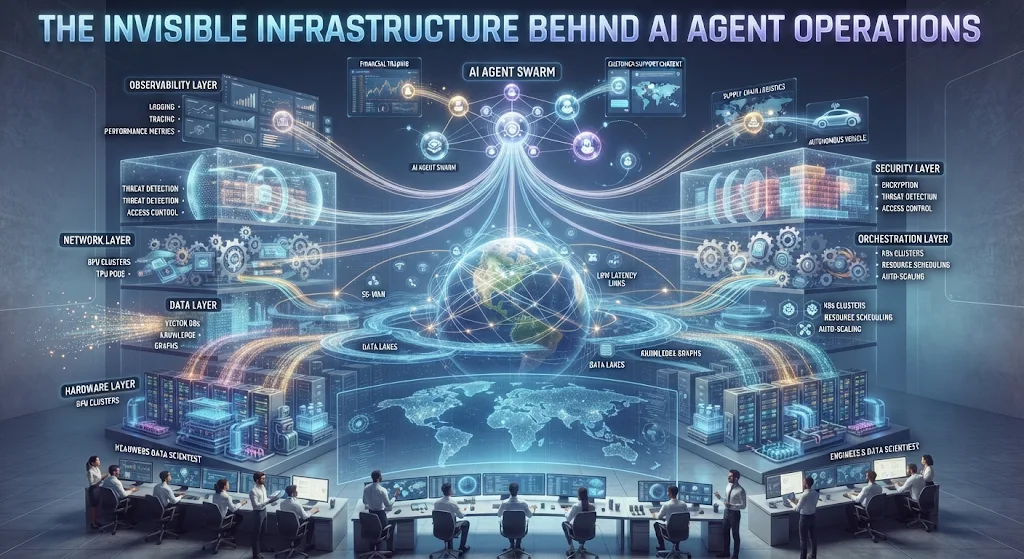
Token prices offer a visible starting point for estimating the cost of an AI agent, but they capture only the model’s billed input and output. A user may submit one instruction, yet the agent can interpret it, plan a sequence of actions, and make several model calls before returning an answer. It may also invoke external tools, inspect files, retrieve documents, query databases, or ask for additional context. Each step can trigger work across systems that do not appear on the model invoice, making token spend an incomplete measure of the workload.
Those actions consume infrastructure in different ways. API requests use service capacity and may count against rate limits or quotas. Database queries and document retrieval require compute, storage access, and network traffic; searches through logs or telemetry can touch large volumes of data. Agents may run tests, retry failed operations, or repeat investigative steps when results are ambiguous. The resulting activity can add load to shared services, increase storage and monitoring requirements, and create operational costs even when a task uses relatively few tokens. These expenses may be recorded in separate cloud, software, or internal platform budgets.
Reports about Uber’s coding-assistant rollout illustrate how quickly adoption can become a budgeting concern: as more developers use an assistant, demand for the supporting systems can rise alongside model usage. Token charges are relevant, but they do not account for every query, test, retrieval, or tool call generated by the agents. Finance teams therefore need to ask not only how many people use the system, but how much work each request initiates. An agent can produce many more machine operations than a human would perform while working through the same task manually. If that activity grows faster than the user count, infrastructure costs may rise disproportionately, even while the visible token bill appears manageable.
Human investigations typically unfold in a sequence: a person checks one system, interprets what they find, then decides where to look next. People also pause to communicate, review evidence, and weigh whether another step is worthwhile. An AI agent can behave differently. Given a goal, it may divide the work into subtasks, launch several branches at once, repeat searches with revised queries, and retry operations that fail. This parallel, iterative pattern can make investigations faster, but it also increases the number of requests generated by a single instruction.
Consider an agent asked to investigate rising checkout latency. It might inspect deployment metadata, search application logs, compare service metrics, analyze distributed traces, and check dependent services. It could repeat those checks across multiple time periods and regions, pursuing each lead independently. Even a modest workflow can expand quickly: five parallel investigation paths, each making five attempts, across three target systems produces 5 × 5 × 3, or 75 operations, from one user request. Retries may follow timeouts or ambiguous results, while parallel branches may revisit overlapping data. A broader incident spanning more services, regions, and time windows can generate hundreds or thousands of operations.
Uncontrolled concurrency and retries create operational risks beyond higher usage charges. A burst of requests may exceed rate limits, trigger throttling, or activate automated security defenses designed to detect unusual traffic. Repeated queries can add load to already strained services, worsening the incident under investigation. External providers may impose separate quotas or restrict automated access, interrupting the workflow or affecting other users of shared credentials. Platform limits therefore serve an important stability function as well as controlling billing. Concurrency caps, retry budgets, backoff delays, and per-system quotas help keep agent activity bounded. These controls allow useful parallel work while reducing the chance that investigation itself contributes to overload or violates a service’s access rules.
Treat each AI agent as a production workload, not an isolated model call. Its observable execution path should begin with the initiating request and continue through every model invocation, tool call, external API, database query, retry, and parallel branch. Tracing this chain helps teams identify where latency, cost, failures, or duplicated work arise, including activity hidden behind orchestration layers. OpenTelemetry offers a vendor-neutral way to collect and correlate traces, metrics, and logs across services, making it easier to follow an agent across providers and infrastructure without tying operational visibility to one platform. Instrumentation should preserve request and operation identifiers while recording timestamps, outcomes, and resource context.
Monitor six dimensions: request amplification, or downstream operations per instruction; concurrency, including simultaneous model and tool activity; retry triggers and frequency; investigation depth, such as the number of steps or sources explored; infrastructure consumption, including compute, storage, and network use; and useful business outcomes. Establish normal operating patterns for each agent and compare activity against them. Investigate deviations such as repeated queries that return the same information, resource use rising without better results, or unusually high request volume. Pair operational measures with outcome measures so teams can distinguish productive exploration from expensive activity that does not advance the user’s goal.
Set explicit controls for every agent. Define operation budgets and concurrency caps, and match depth limits to the agent’s role and task. Require stronger approval before costly or consequential actions, and use loop detection to interrupt repeated steps. Prefer structured tool interfaces that constrain inputs and make results predictable. Configure retries with backoff, respect service rate limits, and stop when another attempt is unlikely to help. These guardrails should be visible in traces and adjustable through policy rather than buried in prompts. Review budgets and thresholds as workloads change, using observed patterns to refine limits without blocking legitimate tasks. Together, consistent tracing and practical controls make agent behavior easier to explain, manage, and improve in production.
Token consumption and request volume are easy to measure, but neither reveals whether an AI agent has delivered useful work. An agent may issue many queries while making little progress, or use more expensive reasoning to resolve a complex task in a small number of steps. Treating raw activity as a proxy for value can therefore reward inefficiency and obscure the real cost of operating agents.
As agents enter software development, incident response, business operations, and machine-to-machine workflows, evaluation should focus on completed tasks and measurable outcomes. Relevant measures might include whether a change passed required tests, an incident was resolved within its service objective, or a workflow completed accurately without unnecessary escalation. These measures should be paired with reliability, latency, and resource use so teams can understand both the result and the cost of achieving it.
A higher-priced model may be less expensive overall if it reaches a correct result efficiently. By contrast, a cheaper model that generates hundreds of unnecessary queries, triggers repeated tool calls, or requires extensive human correction can impose greater costs through compute, system load, and staff time. Comparing models only by price per token or request misses these downstream effects. Cost analysis should account for the full path from task initiation to verified completion.
That analysis also depends on understanding what agents do across connected systems. Inspection rights should not automatically grant permission to modify production resources. Actions that can affect customers, data, availability, or security require distinct authorization and appropriate safeguards; human approval may be warranted when the potential impact is significant. Clear boundaries make it possible to assess both operational value and exposure.
The central management principle is to treat an AI agent as an autonomous workload, not merely another user or a faster human. Organizations should observe activity end to end, understand its infrastructure impact, apply budgets and security limits, and judge performance by useful outcomes. This broader view makes spending more accountable while helping teams expand agent use without losing control of reliability, access, or business risk.