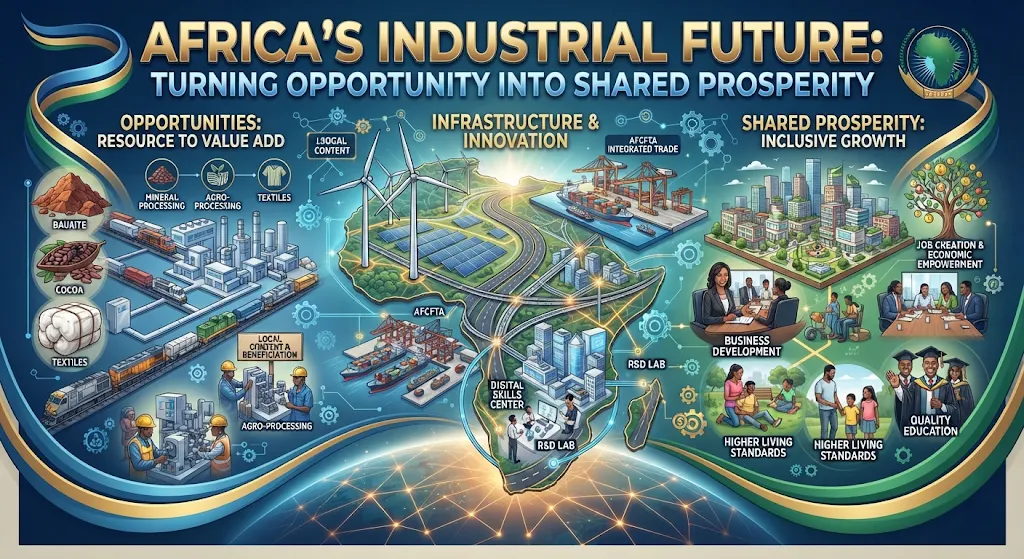
On Africa Industrialization Day, the continent’s ambition is clear: to expand productive industries, create decent jobs, and improve livelihoods across its diverse communities. Industrialization is not simply a matter of increasing factory output. It is about building the capabilities, infrastructure, and enterprises that enable people to turn local resources and skills into greater value. When growth is inclusive, it can strengthen household incomes, widen economic opportunity, and support more resilient communities. Africa’s industrial drive therefore carries significance beyond production statistics: it offers a practical route to shared prosperity and an improved quality of life for people in cities and rural areas alike.
This transformation must also be sustainable. As economies grow, reliable and affordable energy is essential for businesses, services, and households. Expanding clean energy can help power new industries while limiting pollution and reducing exposure to volatile fossil-fuel markets. Investments in renewable electricity, efficient technologies, and modern infrastructure can support both economic development and climate goals. The transition will require planning, financing, and skills, but it also creates opportunities to build industries suited to future needs. Linking industrial growth with cleaner power can help ensure that rising production contributes to lasting benefits rather than adding avoidable environmental costs.
Africa is pursuing this agenda at a pivotal moment. Advances in digital technology, manufacturing methods, logistics, and renewable energy are reshaping how goods and services are produced. These changes create openings for countries to develop new businesses, strengthen regional value chains, and move into higher-value activities. Realizing the opportunity depends on practical choices: improving access to finance and infrastructure, investing in education and technical skills, and creating predictable conditions for enterprise. Cooperation among governments, businesses, workers, and communities will also matter. With sustained effort, the continent can use emerging industries and technologies to broaden productive capacity, generate meaningful employment, and build a more prosperous and sustainable future.
Africa’s industrial prospects are increasingly tied to industries reshaping global production. Electric vehicles, battery systems, computer chips, and renewable energy technologies offer opportunities to build manufacturing capacity, create skilled employment, and broaden exports. The continent holds significant deposits of lithium, cobalt, graphite, manganese, copper, and other critical minerals needed across these sectors. Rather than shipping these resources largely unprocessed, countries can develop refining, component production, assembly, and recycling capabilities at home. This shift could retain more value, strengthen supplier networks, and reduce vulnerability to commodity-price swings. Success depends on reliable power, transport, technical skills, patient investment, and policies that reward local learning.
Renewable energy can support this transition both as an industry and as essential infrastructure. Solar, wind, hydropower, and emerging storage projects can expand electricity access while powering factories, mines, and digital services with lower emissions. African firms can participate in project development, equipment maintenance, and the production of selected components, building expertise over time. In batteries and electric mobility, regional markets could support mineral processing, cell and component manufacturing, vehicle assembly, charging networks, and repair services. Semiconductor production may require substantial investment and specialized capabilities, but opportunities also exist in chip design, testing, packaging, and electronics manufacturing. Targeted investment can connect these activities to local research and training.
Stronger regional and global value-chain links will be essential to scale production beyond individual national markets. The African Continental Free Trade Area can help reduce trade barriers, harmonize standards, and enable firms to source inputs and reach customers across borders. Agenda 2063 provides a broader framework for integration and inclusive development, while the start of the Fourth Industrial Development Decade for Africa offers renewed momentum for industrial transformation. Africa’s expanding role in renewable energy further strengthens the case for green industries and sustainable infrastructure. With coordinated policies, investment, and skills development, these initiatives can help economies move beyond raw-material extraction and capture more economic value within the continent.
Industrial growth depends on foundations that allow businesses to produce reliably, reach markets, and plan for the long term. Affordable, dependable energy is essential: frequent outages or high power costs can disrupt production and discourage investment. Well-maintained roads, railways, ports, and digital networks help move inputs and finished goods efficiently, connecting firms to suppliers, customers, and regional value chains. These systems should be planned together, with attention to cross-border links and the needs of industrial zones as well as smaller towns. When infrastructure works consistently, companies can expand beyond isolated projects and build productive capacity that supports wider economic activity.
Clear, stable policies and proportionate regulation are equally important. Businesses need predictable rules for starting and operating, access to transparent licensing and customs processes, and confidence that contracts and property rights will be respected. Governments can support investment through coordinated industrial strategies, fair competition, and targeted incentives that address genuine constraints without creating lasting dependence on subsidies. Regular dialogue among public agencies, employers, workers, and communities can help policies respond to practical conditions. Consistency matters: frequent changes or unclear responsibilities raise costs and make it harder for firms to commit capital, train staff, and develop local supplier relationships.
Industrial capability also rests on people. Strong basic education, technical and vocational training, apprenticeships, and opportunities for lifelong learning can equip workers for changing production methods and emerging technologies. Training providers should work with employers to identify skills gaps, while inclusive programs widen access for women, young people, and underserved communities. These foundations require sustained financing from both public and private sources. Public investment can provide core infrastructure, education, and institutions; private finance can expand productive firms, innovation, and supply chains. Blended approaches and accountable planning can align contributions with long-term goals. With reliable networks, enabling rules, capable workers, and durable financing, countries can turn new opportunities into industrial capacity that creates broad-based prosperity.
Industrialization requires sustained investment in transport networks, reliable energy, digital technology, workforce skills, and productive firms. Yet many African countries face limited access to affordable, long-term finance, while high interest rates and restricted borrowing options make major projects difficult to fund. Debt-service costs add further pressure: governments must direct substantial public revenue toward repayments, leaving less available for infrastructure, education, innovation, and industrial development. These constraints can delay projects, weaken essential services, and limit countries’ ability to create jobs and move into higher-value production.
Addressing the financing gap requires stronger domestic resource mobilization and more effective access to international capital. The Africa Credit Rating Agency, launched by the African Union and partners, represents an Africa-led effort to respond to concerns about how countries and projects are assessed by credit markets. Its proponents aim to provide analysis grounded in African conditions and support more informed financing decisions. Such an institution cannot replace broader reforms or remove economic risks, but it can contribute to a more diverse financial landscape and strengthen African participation in evaluating investment opportunities.
The 2025 Sevilla Commitment offers a framework for mobilizing domestic and international resources, from both public and private sources, to advance sustainable development. It also recognizes the pressure that debt burdens place on developing countries and the need for financing approaches that support investment rather than intensify fiscal constraints. Turning commitments into results will require transparent partnerships, suitable financing terms, and practical support for countries seeking to build productive capacity. More broadly, overdue changes to the global financial architecture are essential. Developing economies need stronger support, fairer representation in international institutions, and a meaningful role in decisions that shape their development. A system that listens to their priorities and shares risk more equitably can help unlock investment, expand industrial opportunity, and make prosperity more widely shared.