The European Space Agency (ESA) has commissioned OVHcloud and CGI to develop Digital EO, a new information system intended to make Earth observation resources easier to find and use. The 30-month contract, valued at several million euros, brings together expertise in cloud infrastructure and digital systems to address a growing need across Europe’s space sector. Rather than treating satellite data as a collection of separate archives, the project is designed to provide a coordinated environment in which information, computing resources, and supporting services can work together.
Digital EO’s central purpose is to connect Earth observation data with the processing capacity needed to analyse it and the services required to turn results into practical information. The platform will operate within European infrastructure, helping users access resources without having to assemble every component independently. That approach is intended to lower technical barriers, simplify workflows, and support a wider range of applications, from scientific research and public planning to commercial services. Researchers, public agencies, businesses, and citizens are among the intended users, although their needs and levels of technical expertise differ.
The initiative also responds to the sheer scale of the data challenge. ESA expects its Earth observation holdings to exceed 500 petabytes by 2035. As satellite missions continue to generate large volumes of imagery and measurements, storing those records is only part of the task: users must also be able to locate relevant data, process it efficiently, and interpret the resulting information. A shared system could help make these steps more accessible and manageable. The project therefore has both a practical and a strategic dimension, supporting day-to-day use while strengthening Europe’s ability to manage and benefit from a rapidly expanding space-derived resource.
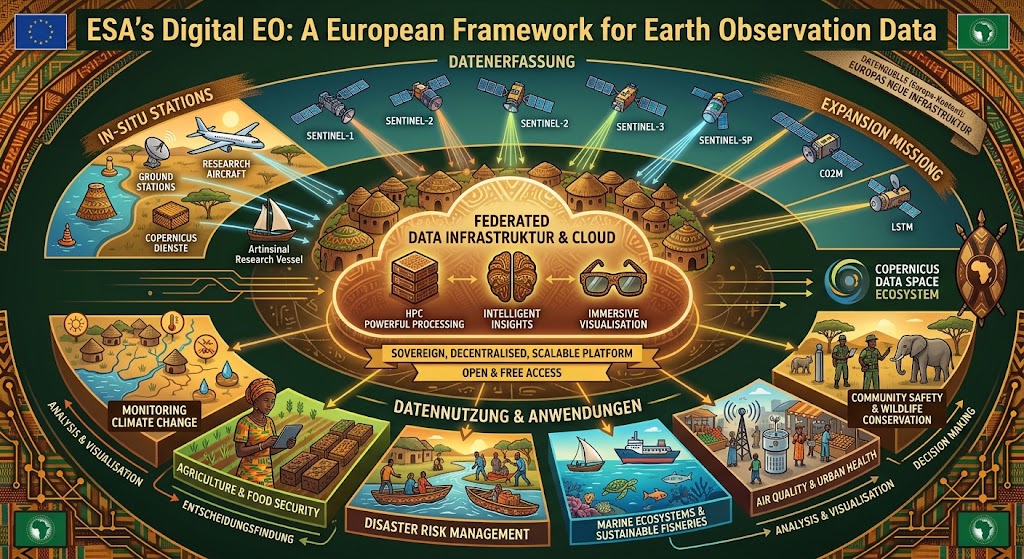
Digital EO is conceived as a federated, decentralized framework, not as a single repository into which every European Earth observation dataset must be copied. Its technical approach is intended to connect distributed data holdings, services, and infrastructure while allowing participating systems to retain their own arrangements. This model can support growth across a diverse landscape: new sources and capabilities may be linked as needs evolve, without requiring one central facility to store or operate everything. Decentralization is also intended to strengthen resilience, reducing reliance on a single point of access or failure and enabling resources to be reached through cooperating infrastructures.
The platform is intended to manage the interplay between varied, large-scale Earth observation datasets and the computing capacity and artificial intelligence resources needed to use them. Rather than treating data, processing, and models as separate concerns, Digital EO is expected to make these capabilities available in connected workflows. Links with national and European infrastructures are central to this design, helping users discover and access resources across institutional and geographic boundaries. Federation can allow existing platforms and systems to work together through appropriate connections, rather than forcing them into a replacement architecture. In this way, broader access can be pursued while existing investments, expertise, and operational responsibilities remain relevant.
Digital EO is also envisaged as an environment for developing, delivering, and governing algorithms, applications, and services created by users across science, government, industry, and civil society. Its federated structure can support collaboration between these communities while connecting their work with the data and computing resources required to turn ideas into usable tools. The European Space Agency has stated that Digital EO is intended to support European Commission programmes, including Copernicus and Destination Earth (DestinE). This relationship is framed as complementary: the platform can help connect resources and enable new uses, rather than replace either programme. Its broader purpose is to make Europe’s Earth observation capabilities more accessible and interoperable, while respecting the roles of existing systems and initiatives.
OVHcloud is contributing the cloud infrastructure that underpins Digital EO, supplying computing capacity, data storage, networking and managed cloud services. These components provide the technical foundation for processing and making Earth observation information available through the platform. The arrangement places a European cloud provider at the operational core of a project intended to support access to valuable environmental data, while offering the resources needed to run digital services at scale. OVHcloud’s contribution is therefore not limited to hosting files: it encompasses the infrastructure and managed capabilities required to operate the platform and its services.
The initial deployment is planned across Italy, France and Germany, with support capabilities operated from Poland. This distribution establishes a multi-country European footprint for the platform’s first phase. OVHcloud has also indicated that the infrastructure could later extend to additional European countries and Canada, creating scope for geographic expansion as project needs develop. The company has described its commitment as extending over time, with the ability to respond to requirements that may change as Digital EO evolves. That includes attention to performance and resilience, as well as adapting services to the needs of users and the platform itself.
The infrastructure model also relates directly to Digital EO’s sovereignty objective: maintaining control of strategic infrastructure and services within a European framework. Cloud location and operational arrangements matter in this context because they shape where essential services are provided and how the underlying systems are governed. OVHcloud founder and CEO Octave Klaba has presented sovereign cloud and infrastructure control as central considerations for the project. His comments frame the provider’s role as part of a broader effort to build European capacity, rather than simply as a technical hosting choice. In practice, the stated approach combines distributed infrastructure, managed cloud services and a commitment to support the platform as its requirements develop, while keeping strategic control aligned with the project’s European aims.
CGI’s role in ESA’s Digital EO initiative is to act as platform integrator and architect, helping shape the Digital EO backbone: the technological and operational core that is intended to connect data, services and users. Rather than functioning as a single-purpose data repository, the platform is being designed to help organizations manage Earth observation datasets and services while supporting the communities that use and develop them. CGI is expected to contribute to user and developer support and to the ongoing evolution of the system as needs and technologies change.
CGI says its work draws on company expertise in cybersecurity, data management, artificial intelligence and digital systems for the space sector. These capabilities are relevant to designing and operating a complex platform that must bring together varied resources and users. They describe CGI’s stated experience and contribution, however, not independently established results or proof that the planned benefits have already been achieved. The platform’s performance and longer-term impact will depend on implementation, collaboration among participating organizations and continued development.
ESA’s Nicolaus Hanowski has framed the initiative in terms of making Earth observation resources more accessible and useful across Europe, while CGI France president Didier Thérond has emphasized CGI’s role in supporting the project and its digital foundations. Their remarks reflect the project’s intended direction; they should be understood as statements about its aims rather than evidence of outcomes already delivered.
Together, these responsibilities and ambitions point toward a robust, adaptable European environment for Earth observation. The project seeks to encourage cooperation among existing infrastructures instead of treating them as isolated systems, while enabling organizations and user communities to connect with relevant data and services. Its broader strategic ambition is to strengthen European control over important data capabilities and the digital systems that support them. Digital EO is therefore both a platform-integration effort and a framework for closer coordination: a proposed way to develop shared capabilities while allowing existing resources to contribute. Whether it achieves that vision will depend on how effectively the backbone supports diverse participants and evolves with their requirements.