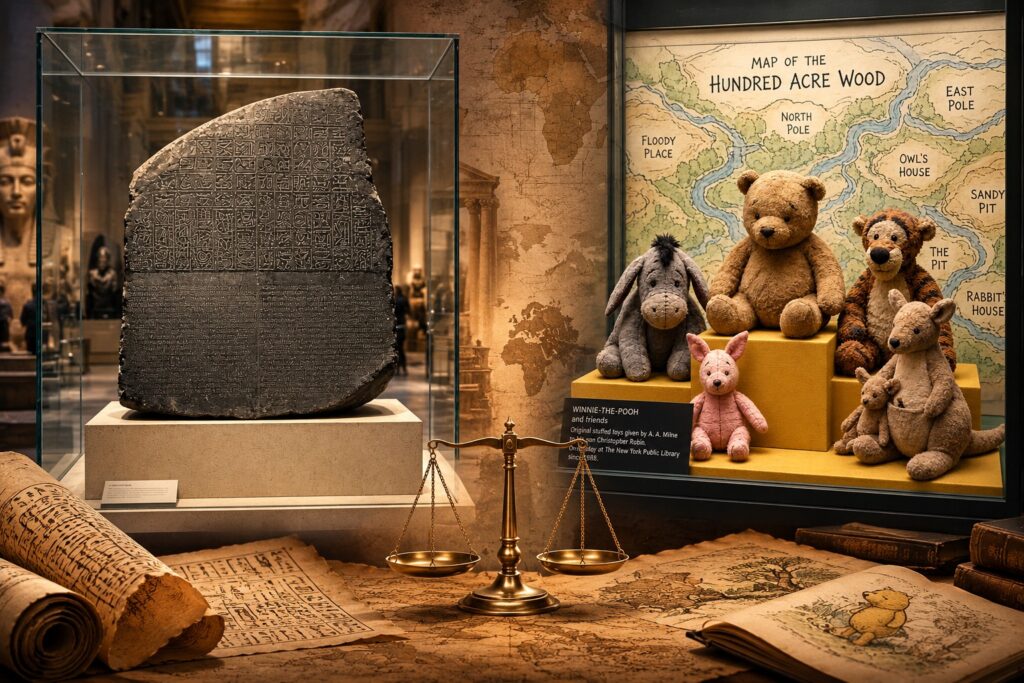



Is there a connection between Egypt’s Rosetta Stone and the English children’s teddy bear, Winnie-the-Pooh? Following my lecture in Brussels on 5 October 2026, launching the Initiative for the Reassessment of Historical Legitimacy and Cultural Heritage, I was surprised by a comment on my book, Reflections on an Era of Diminished Politics, from Professor Orouba Al-Mansouri of Brooklyn College, New York. She remarked: “How similar yesterday is to today! The New York Public Library refused to return or lend the original Winnie-the-Pooh teddy bear to England. In 1998, New York Mayor Rudolph Giuliani opposed its return, defending the toys’ continued presence in New York by describing Pooh as ‘an immigrant who had settled in his new homeland’! And the refusal continued into 2026, when Britain sought to celebrate the book’s centenary.”
I listened with rapt attention to Professor Al-Mansouri. It seems that 2026, even as it draws to a close, still has surprises in store! As though the escalating unrest and wars across the world—internationally, regionally, and locally—and the French legislative precedent concerning the restitution of certain cultural properties under Law No. 2026-351 were not enough, the year has brought me two further revelations.
The first was that the British Museum had confirmed that, as of November 2025, it had received no formal request from the Egyptian government for the repatriation of the Rosetta Stone! This, however, does not conclusively establish that no official Egyptian communications or correspondence took place with other British authorities, nor does it establish that the situation remained unchanged through October 2026.
The second was that, when British efforts were renewed in 2026 to mark the centenary of Winnie-the-Pooh, the New York Public Library also declined to allow the original teddy bear to travel temporarily, citing its age and fragility, the risks of transportation, and its importance to the library’s visitors. The American position thus rested on the history of the transfer of ownership, institutional preservation, and public access, while the British appeal was grounded in literary and cultural belonging.
To understand why Great Britain would witness a parliamentary demand for the return—or a royal-associated initiative for the temporary loan—of a children’s teddy bear that had “legally migrated” to America in 1947, I felt compelled to investigate the matter. I wanted to understand the circumstances of both the request and its rejection, and to compare them with Egypt’s position regarding the recovery of the Rosetta Stone!
The story of Winnie-the-Pooh began in 1921, when the British author A. A. Milne bought a teddy bear for his son, Christopher Robin. The toy later inspired the celebrated literary character in Milne’s 1926 book, Winnie-the-Pooh. In 1947, the bear and its companions were taken to America for promotional purposes by the American publisher E. P. Dutton. According to accounts of their provenance, the publisher subsequently acquired the toys from Milne’s estate in 1956 and donated them to the New York Public Library in 1987, where they became part of its cultural collection on public display.
When British Labour MP Gwyneth Dunwoody visited the New York Public Library and saw the original toys preserved behind glass, she called in Parliament for their return to Britain as part of its literary and cultural heritage. She explicitly compared Britain’s claim to Winnie-the-Pooh with Greece’s demand for the return of the Parthenon sculptures from the British Museum. The British culture minister, however, did not endorse her proposal, observing that the toys were well cared for and accessible to a wide public audience in New York.
The efforts resurfaced in 2026, on the centenary of the book’s publication, through an initiative associated with Queen Camilla to arrange a temporary loan of the toys to Britain—not a legal claim for the transfer of their ownership.
At this point, I recalled my Initiative for the Reassessment of Historical Legitimacy and Cultural Heritage and the question of Egypt’s claim to the Rosetta Stone. The discovery of the stone provided a crucial key to deciphering Egyptian hieroglyphs, opening the way for humanity to read the history of ancient Egyptian civilization. Yet the stone passed from the French expeditionary forces to Britain under the terms of a military capitulation in 1801, without the participation or independent consent of an Egyptian national authority capable of determining the fate of its own cultural heritage.
The British Museum maintains that the transfer was legitimate and that the stone should remain in its collection. By contrast, certain British parliamentarians did not hesitate to call for the return of Winnie-the-Pooh from New York, notwithstanding the circumstances of its consensual transfer, on the grounds that it represented a symbol of Britain’s literary and cultural heritage.
Between these two positions arises a question that transcends the differences in historical significance and the legal circumstances surrounding the two objects: Why is cultural belonging invoked to justify a British demand for the return of a teddy bear, while that same belonging—combined with objections to the historical circumstances of the transfer of ownership—is considered insufficient even to reopen the discussion surrounding Egypt’s claims to the Rosetta Stone?
The point is that Britain understands very well the significance of a cultural symbol’s connection to its place of origin, even where its transfer abroad occurred consensually. This is precisely what makes the British appeal concerning the teddy bear useful when examining the British Museum’s position on the Rosetta Stone, without suggesting that the two cases are legally identical.
If a transfer of ownership does not, in the eyes of the British claimants, extinguish the cultural connection between a teddy bear and its homeland, how can the transfer of the Rosetta Stone between two foreign armies, under conditions of war and capitulation and without independent Egyptian consent, be regarded as sufficient to close the debate over its connection to Egypt and the legitimacy of its continued presence abroad?
Yet the significance of this paradox extends beyond the different nature of the objects and the circumstances of their transfer. It raises a more fundamental question concerning the very methodologies through which cultural heritage claims are pursued!
In Britain, the efforts concerning the teddy bear began with a parliamentary initiative, remained alive in cultural memory and the press, and resurfaced during the book’s centenary, eventually attracting
attention through an initiative associated with Queen Camilla for a temporary loan. The matter did not, however, become a formal dispute between the British and American governments.
By contrast, the British Museum stated, in a response dated 13 November 2025, that it had received no formal request from the Egyptian government for the repatriation of the Rosetta Stone, despite campaigns by Egyptian archaeologists and intellectuals. Although this statement does not rule out possible communications or correspondence with other British authorities, it raises a legitimate question about the clarity of the institutional process for pursuing such a claim and the authority responsible for preparing, managing, and following it through.
Egypt has, of course, undertaken substantial efforts to recover other antiquities, and the absence of a documented formal governmental request to the British Museum does not mean that Egypt has shown no interest in the Rosetta Stone. Nevertheless, I came to the conclusion that the difficulty does not always lie solely in the willingness of the holding state to return a cultural object. It may also begin with the readiness of the state of origin to transform a cultural claim into a formal, documented case for which its institutions assume responsibility.
In this context, the initiative associated with Queen Camilla is significant—not as a legal argument for the restitution of antiquities, but as an illustration of how high-level institutional interest in cultural heritage can extend even to seeking the temporary loan of a teddy bear. By contrast, the recovery of a civilizational symbol of the Rosetta Stone’s magnitude calls for a clear Egyptian institutional process that brings together historical arguments and properly documented legal and diplomatic claims.
Herein lies the true paradox! It is not simply that Britain seeks a teddy bear while Egypt seeks a stone, nor is it a question of comparing their respective historical or cultural values. Rather, the distinction lies between expressing pride in a cultural symbol and possessing the institutional capacity to translate that pride into formal actions capable of being documented, examined, and followed through.
The reassessment of historical legitimacy cannot be confined to revisiting the rules governing the transfer of cultural property. It must also extend to reconsidering the methodologies through which claims to such property are formulated and pursued.
Opening new legal avenues cannot substitute for the institutional resolve required of claimants: the capacity to prepare documented dossiers, identify their historical and legal grounds, initiate formal procedures, and employ the diplomatic and cultural mechanisms appropriate to each case. This calls for assisting states of origin and communities with legitimate cultural interests in developing structured, properly substantiated claims, rather than relying exclusively on general appeals, media campaigns, or scholarly initiatives, however valuable these may be.
The French precedent demonstrates the possibility of opening a process of review within the holding state. Winnie-the-Pooh illustrates how a party with a cultural interest can keep its claim alive and mobilize institutional attention. The Rosetta Stone, meanwhile, raises a fundamental question about the
gap between the strength of historical and civilizational arguments and the effectiveness of the means of pursuing a claim, its legal and historical grounds, and its formal institutional status.
Thus, it is not enough for the Initiative to re-examine the legitimacy of the transfer of cultural heritage from states of origin, during periods of diminished sovereignty, to holding states. It must also contribute to developing new methodologies for pursuing such claims, going beyond existing mechanisms and approaches, including the one-directional framework reflected in the French precedent.
This calls for forging new intellectual and legal frameworks capable of laying the foundations for new principles of international law. Such frameworks would re-examine the consequences of the historical absence of free and independent consent, and the extent to which the national interests of the state of origin should be taken into account in establishing the foundations and proper legal grounds of a claim.
The ultimate objective is to develop more equitable pathways for reassessing historical legitimacy, determining appropriate means of pursuing claims, and evaluating the possible outcomes and their implications for both parties, without presuming that restitution—or any other particular solution—must necessarily follow before the historical and legal examination is complete.
So, is it enough to call upon the world to restore respect for our civilizational memory if we ourselves have not first demonstrated the institutional will necessary to reclaim it?
By Mohamed Bakri
Attorney before the Court of Cassation | Legal Researcher in History