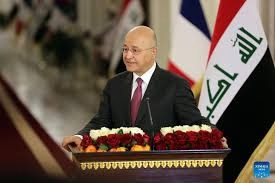
Introduction to Barham Ahmed Salih
Barham Ahmed Salih, an influential Kurdish politician, has recently been recognized for his leadership skills and commitment to humanitarian causes through his election as the UN High Commissioner for Refugees. His extensive background in governance and public service showcases his capabilities and dedication to addressing critical global issues.
Born in 1960 in Sulaymaniyah, Iraq, Salih pursued his education in the United States, where he earned a Bachelor’s degree in Computer Engineering from the University of Utah. This technical background has influenced his analytical approach towards governance and public policy. Salih’s educational journey not only equipped him with essential skills but also exposed him to diverse perspectives that would shape his understanding of international relations and humanitarian efforts.
Throughout his political career, Salih has held several prominent positions. Notably, he served as the President of Iraq from October 2018 to March 2022, during which he focused on fostering stability and promoting inclusive governance. Prior to this role, he was the Prime Minister of the Kurdistan Regional Government (KRG), where he implemented significant reforms aimed at enhancing administrative efficiency and addressing economic challenges faced by the region.
His tenure in various governmental roles reflects his commitment to the welfare of displaced populations, as he has actively engaged in discussions surrounding refugee policies and rights. In addition to his domestic achievements, Salih’s experience on the international stage, including participation in numerous conferences and diplomatic initiatives, underscores his readiness to assume a crucial global leadership position.
With his blend of technical knowledge, leadership experience, and dedication to humanitarian principles, Barham Ahmed Salih is well-positioned to address the complex challenges facing refugees today as the newly appointed UN High Commissioner for Refugees.
Significance of the Election
The election of Barham Ahmed Salih as the UN High Commissioner for Refugees holds considerable significance within the framework of international governance and humanitarian efforts. This role, pivotal in addressing global refugee crises, encapsulates various challenges that necessitate effective leadership and strategic vision. The UN High Commissioner for Refugees is tasked with safeguarding the rights and well-being of millions displaced by conflict, persecution, and disasters worldwide.
Global refugee crises have escalated in recent years, with the number of forcibly displaced individuals surpassing historical records. Factors such as armed conflicts, climate change, and economic instability have contributed to the increasing influx of refugees seeking safety and a better future. As the newly appointed High Commissioner, Salih’s background in diplomacy and governance presents an opportunity to inspire collaborative solutions that address both immediate needs and long-term structural challenges.
Salih’s election comes at a crucial juncture, where the plight of refugees demands urgent attention and action. His prior experiences, including his leadership roles in Iraq and contributions to international platforms, may inform his approach to creating policies that promote advocacy, resource mobilization, and comprehensive strategies for refugee support. Furthermore, Salih’s understanding of regional complexities and his commitment to human rights can enhance the UNHCR’s efforts to engage not only with host countries but also with communities impacted by displacement.
In this context, Salih’s election symbolizes renewed hope and vigor within the UN system to tackle one of the most pressing humanitarian issues of our time. As he steps into this crucial position, the expectation is to foster collaboration across nations and advocate for innovative solutions to support the rights and welfare of refugees while acknowledging the broader geospatial and socio-political landscapes contributing to these crises.
Acknowledgment of Filippo Grandi’s Tenure
Filippo Grandi has served as the United Nations High Commissioner for Refugees (UNHCR) since January 2016, and his tenure has been marked by significant challenges and accomplishments in the field of humanitarian assistance. Under his leadership, the UNHCR effectively responded to an unprecedented global displacement crisis, which saw the number of forcibly displaced people surpass 80 million worldwide, including refugees, asylum seekers, and internally displaced persons. Grandi’s efforts were instrumental in highlighting the complex realities faced by refugees, fostering a greater international response to their plight.
Grandi prioritized key initiatives that aimed to enhance the protection of refugees and support host communities. Through his dedication, the UNHCR advanced the Global Compact on Refugees, which aimed to improve international cooperation and provide comprehensive solutions to the refugee crisis. His emphasis on partnerships with governments, NGOs, and civil society organizations enabled a multifaceted approach to addressing the needs of displaced individuals, thereby expanding opportunities for integration and self-sufficiency.
Moreover, Grandi excelled in advocating for the rights and welfare of refugees on a global stage. He engaged in high-level dialogues with world leaders and mobilized support for critical funding, ensuring that humanitarian programs remained robust despite operating in a constrained fiscal environment. His commitment to protection-centered approaches has significantly influenced policies that aim to avoid the marginalization of refugees.
As Barham Ahmed Salih takes on the role of High Commissioner for Refugees, the transition from Grandi’s tenure to his leadership is anticipated to be smooth. Salih aims to build on the foundation laid by Grandi, maintaining the UNHCR’s mission to safeguard the rights and well-being of refugees and displaced persons while addressing emerging challenges with renewed vigor and focus.
Future Directions for the UNHCR under Salih’s Leadership
As Barham Ahmed Salih assumes the pivotal role of UN High Commissioner for Refugees (UNHCR), his leadership may usher in transformative shifts within the organization. Known for his rich background in governance and international relations, Salih’s unique blend of experience positions him to address the multifaceted challenges facing refugees globally. His potential priorities may involve reinforcing humanitarian responses, bolstering international collaboration, and reforming refugee policies.
A pronounced focus on humanitarian response seems likely under his guidance. With the ongoing refugee crises across various regions, enhancing the speed and efficiency of aid delivery will be essential. Salih might advocate for a more adaptive approach, ensuring that the UNHCR can respond effectively to sudden influxes of displaced populations due to conflict or natural disasters. This adaptability could also extend to leveraging technology and innovative practices for better outreach and assistance.
International collaboration stands as another potential priority. Salih’s diplomatic expertise may foster stronger partnerships between nations and organizations. Advocating for the global responsibility-sharing model could be pivotal; countries bearing the brunt of refugee inflows often require support from the international community. He may also endeavor to strengthen the UNHCR’s relationships with non-governmental organizations (NGOs) and civil society, recognizing their vital roles in providing assistance and advocating for refugee rights.
Furthermore, Salih will likely confront numerous challenges as he navigates his new role. The global political environment is increasingly complex, often hindering constructive collaboration. Managing differing national interests while advocating for humane refugee policies will be critical for his success. Nevertheless, Salih’s appointment has sparked renewed hope, and the global community remains keen to see how his vision unfolds within the UNHCR, particularly regarding refugee protection and durable solutions for displaced populations.