Introduction: Context and Significance of the Gaza Administration Plan
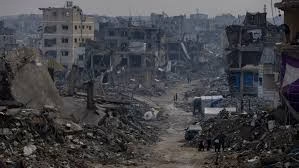
The Gaza Administration Plan, recently announced by the US President, has emerged as a crucial initiative amidst the ongoing humanitarian crisis in the Palestinian territories. This plan addresses the immediate needs of civilians affected by the prolonged conflict while aiming to establish a framework for sustainable governance in Gaza. The significance of this plan cannot be understated, as it seeks not only to alleviate humanitarian suffering but also to lay the groundwork for potential long-term peace and stability in the region.
The primary objectives of the Gaza Administration Plan include the restoration of essential services, enhancement of security, and support for the economic revitalization of Gaza. By focusing on these core areas, the plan aims to improve the living conditions of civilians who have faced numerous hardships due to ongoing hostilities and blockades. Furthermore, it emphasizes the importance of coordinated efforts among various stakeholders, including non-governmental organizations, local authorities, and international partners, to ensure effective implementation of the plan.
The role of the United Nations and its Secretary-General is paramount in this context. The UN has been actively involved in delivering humanitarian assistance and advocating for the rights of the Palestinian people. The Secretary-General’s support for the Gaza Administration Plan underscores the international community’s commitment to resolving the crisis and facilitating a more stable governance structure in Gaza. By aligning this plan with established international resolutions, the UN aims to foster a collaborative environment that prioritizes the welfare of civilians while paving the way for broader peace negotiations.
Key Features of the Phase Two of the 20-Point Plan
The second phase of the 20-point plan for Gaza is designed to facilitate a transformation in the administration of the region, specifically through the establishment of a transitional technocratic Palestinian administration. This initiative is rooted in the recognition of a pressing need for effective governance that can address the socio-economic challenges faced by the populace. By emphasizing a technocratic approach, the plan seeks to prioritize efficiency and expertise over political considerations, thereby positioning qualified individuals in administrative roles who can implement effective policies for recovery and development.
Furthermore, a national committee dedicated to the governance of Gaza is being formed as part of this phase. This committee aims to play a crucial role in shaping the policies and strategies required for reconstruction and stabilization. By collaborating with international organizations and leveraging external resources, the committee is anticipated to create a conducive environment for development initiatives. Such collaboration could enhance infrastructure, improve access to basic services, and foster economic opportunities which are vital for the long-term viability of Gaza’s administration.
The underlying goals of these initiatives are twofold. First, they aim to facilitate immediate recovery by addressing urgent humanitarian needs and creating a framework for the delivery of essential services. Second, they seek to establish a sustainable administrative structure that can adapt to the evolving socio-political landscape of Gaza. The hope is that this renewed governance approach will not only enhance living conditions but will also pave the way for greater stability and prosperity in the region. Through systematic implementation and evaluation, the transitional administration as outlined in the 20-point plan is positioning itself as a catalyst for positive change.
Alignment with UN Resolutions and International Law
The alignment of the Gaza Administration Plan with existing United Nations resolutions and international law is crucial for establishing a legitimate and effective governance structure within the region. This is particularly emphasized by Security Council Resolution 2803 (2025), which outlines fundamental principles for political initiatives in conflict-affected areas. Ensuring compliance with such guidelines not only strengthens the legal basis of the Gaza Administration Plan but also enhances its prospects for recognition by the international community.
International law serves as the framework within which all political actions must operate. The Gaza Administration Plan must consider human rights declarations and humanitarian laws that guide the conduct of states and non-state actors alike. By adhering to these legal standards, the planned governance structure can provide a stable environment for its citizens, fostering trust and cooperation among diverse groups. Moreover, alignment with international resolutions paves the way for increased support from international actors, facilitating critical humanitarian aid and reconstruction efforts.
Incorporating UN resolutions into the planning and implementation processes is not merely a formality; it represents a commitment to uphold principles that reflect the values of democracy, peace, and security. These principles are vital for any governance initiative. The legitimacy conferred by compliance with international standards can bolster the credibility of the Gaza Administration and encourage stakeholder engagement, both locally and globally. Hence, ensuring that the Gaza Administration Plan is consistent with UN guidelines not only addresses the immediate needs of the population but also reinforces long-term peace endeavors within the region.
The Role of the UN and Future Prospects for Peace
The United Nations (UN) has played a pivotal role in the enduring quest for resolution within the Palestinian-Israeli conflict. Echoing the sentiments of various international resolutions, the UN remains committed to fostering dialogue and diplomatic engagement aimed at establishing a lasting peace through a negotiated two-state solution. This vision envisions a secure Israel living alongside a sovereign Palestinian state, thus addressing the fundamental aspirations of both peoples.
Through its agencies, the UN actively engages with both communities, offering humanitarian assistance to alleviate the immediate suffering of Palestinians while also supporting initiatives that build the capacity for peace. Efforts such as promoting economic development in Palestinian territories are essential in creating an environment conducive to dialogue. The UN’s dedication to combating the humanitarian challenges faced in Gaza is a testament to its commitment to not only the Palestinian people but also to the larger framework of regional stability.
Looking towards the future, the UN emphasizes the necessity of international cooperation in facilitating peace initiatives. The complex dynamics inherent in the conflict require that nations work collaboratively to support frameworks that resonate with the values of justice and mutual recognition. This includes engaging regional actors who can contribute to an inclusive dialogue that respects the rights and security of both Israelis and Palestinians.
The path to peace is fraught with challenges; however, the foundational principles laid out by the UN can guide both sides toward a resolution. It is essential that all parties remain committed to the peaceful coexistence that international resolutions advocate. Ultimately, achieving a sustainable peace demands unwavering dedication, strategic diplomacy, and a steadfast commitment to the principles of human rights and self-determination.